
ChatGPT is becoming more than a place to ask questions. It’s also becoming a platform where businesses can advertise to potential customers as they explore products, compare services, and make decisions. With OpenAI expanding ChatGPT ads to more than 60 countries, advertisers now have an opportunity to experiment with a different kind of digital advertising, one built around the context of a conversation.
The expansion comes at a significant moment for OpenAI’s advertising business. By the end of August 2026, ChatGPT Ads had reached a $1 billion annualized revenue run rate, less than 200 days after launch. Tens of thousands of advertisers have already started using the platform, highlighting growing interest in reaching consumers through AI-powered experiences.
For businesses familiar with Google Ads and Meta Ads, the arrival of another advertising platform raises important questions. How does advertising on ChatGPT actually work? What does it cost? And, more importantly, is it worth including in an existing digital marketing strategy?
Where Are ChatGPT Ads Available?
On September 23, 2026, OpenAI announced that ChatGPT advertising was expanding into seven additional Asian markets: Indonesia, Malaysia, the Philippines, Singapore, Thailand, Vietnam, and Taiwan. The announcement followed earlier launches in Australia, New Zealand, Japan, South Korea, and India, bringing the platform’s international reach to more than 60 countries.
The expansion gives advertisers access to markets across North America, Latin America, Europe, Asia-Pacific, the Middle East, and North Africa. Countries currently supported by ChatGPT Ads Manager include Canada, the United States, Mexico, Brazil, the United Kingdom, Germany, France, Spain, Japan, India, and the United Arab Emirates, among others.
However, businesses should understand that advertiser availability and ad delivery are not necessarily the same thing. A country’s eligibility for Ads Manager does not automatically mean that every ChatGPT user in that market will see advertisements.
To access self-service advertising, the legal entity responsible for the account and billing must be based in a supported country. Some new advertiser accounts may also initially be restricted to running campaigns in their home country until they complete identity verification and meet the required advertising spend.
Eligible businesses can register directly through ChatGPT Ads Manager, while larger advertisers may work with OpenAI’s advertising team or its partners. Businesses can also consult OpenAI’s official Ads Manager availability list to confirm whether self-service access is supported in their country.
For Canadian businesses, this means ChatGPT advertising is already an option worth evaluating. Companies interested in reaching international audiences should also review the geographic targeting restrictions associated with their accounts before planning campaigns across multiple countries.
How Is Advertising on ChatGPT Different From Google Ads?

Imagine someone looking for customer relationship management software for a growing business. On Google, they might search for “best CRM for small businesses” and compare the results. On ChatGPT, they could explain that they manage a team of ten people, need an affordable solution, and want software that integrates with their existing tools.
Both experiences demonstrate commercial interest, but the information available about the person’s needs differs.
Traditional search advertising frequently relies on keywords and search intent to connect advertisers with users. ChatGPT advertising considers the broader context of a conversation, including a person’s goals, preferences, challenges, and the options they are evaluating.
Rather than relying exclusively on individual search terms, OpenAI’s advertising system evaluates several relevance signals, including conversational context, advertiser messaging, landing page information, and additional context provided during campaign setup.
For example, a travel company offering guided European tours might be relevant to someone discussing vacation destinations, travel preferences, and available budgets. Similarly, a software provider could potentially reach someone exploring tools to simplify business operations.
Advertisements appear separately below ChatGPT responses and are clearly identified as sponsored content. They can include an advertiser’s name, headline, description, image, and a link to a landing page.
This distinction is important because ChatGPT ads do not replace traditional search advertising. Google Ads remains useful for reaching people who are conducting searches, while ChatGPT introduces another opportunity to engage users during research and consideration. For marketers, understanding how these experiences complement each other can help determine where different campaigns belong within the customer journey.
How Does ChatGPT Ads Manager Work?
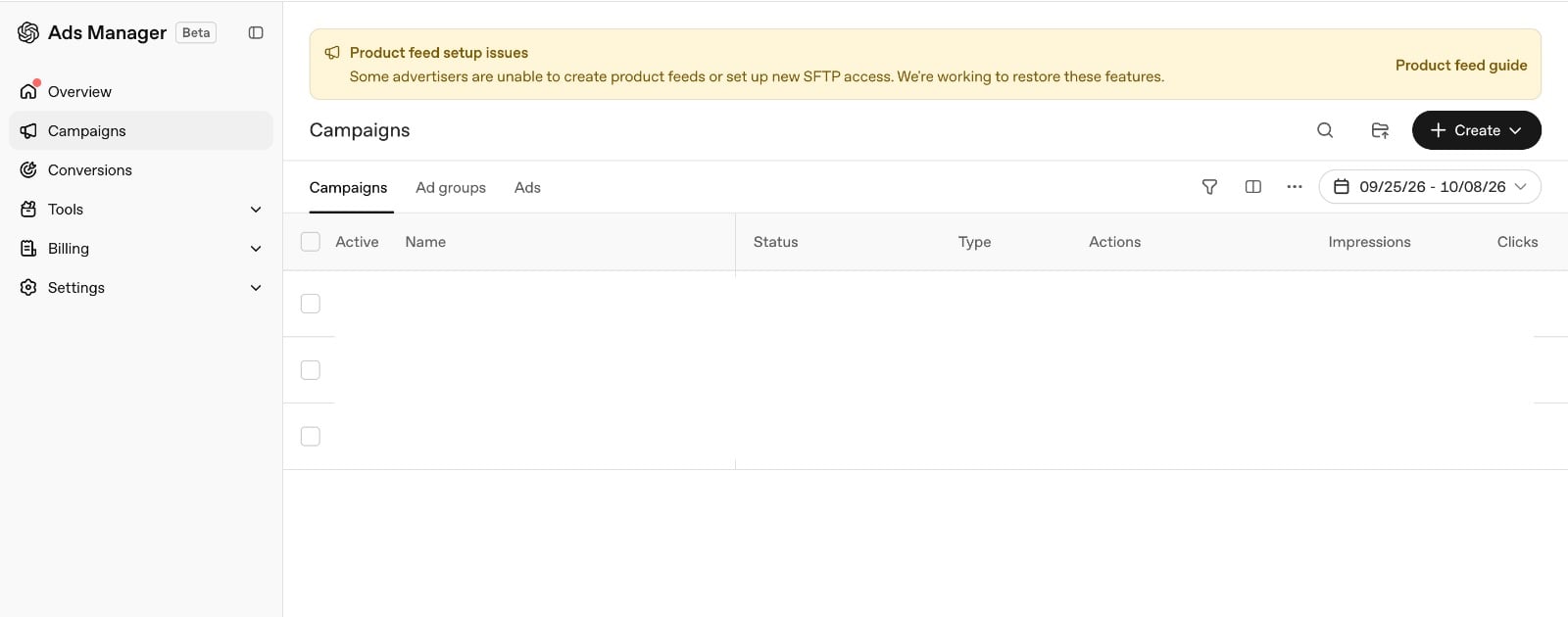
OpenAI has introduced a self-service advertising platform that allows eligible businesses to create campaigns, manage budgets, select geographic markets, and monitor performance.
Through ChatGPT Ads Manager, advertisers can organize campaigns around specific business objectives, such as generating awareness, attracting website visitors, or encouraging conversions. Each campaign contains ad groups and individual advertisements, allowing businesses to develop different messages for different products, services, or customer needs.
One feature that distinguishes the platform is the use of context hints. These allow advertisers to describe situations where their products or services may be relevant. For example, a business selling ergonomic office chairs might provide context by noting that people are furnishing home offices or looking for comfortable seating during long working hours.
Unlike traditional exact-match keywords, context hints help OpenAI’s system understand relevance without guaranteeing that an advertisement will appear during a particular conversation. Advertisers still need clear messaging, suitable creative assets, and landing pages that accurately reflect their offerings.
Campaign performance can be evaluated through metrics such as impressions, clicks, click-through rates, advertising spend, and conversions. OpenAI also supports conversion measurement through its Pixel and Conversions API, helping businesses connect advertising interactions with actions taken on their websites.
These capabilities make ChatGPT Ads Manager increasingly familiar to businesses already managing paid campaigns. However, because the platform is still developing, advertisers should regularly review changes to its targeting, creative, and optimization features.
How Much Do ChatGPT Ads Cost?
Advertising costs are one of the most important considerations for businesses exploring a new platform. ChatGPT Ads currently supports several campaign objectives and billing models, allowing advertisers to choose options based on their goals.
Businesses focused on visibility can use impression-based campaigns, commonly known as cost per thousand impressions (CPM), where advertisers pay for every 1,000 ad impressions served. Those interested in driving website traffic can choose cost-per-click (CPC) campaigns, in which charges are based on actual clicks.
OpenAI also supports conversion-optimized campaigns designed to prioritize actions such as purchases, registrations, or lead submissions. Depending on eligibility and campaign configuration, these campaigns can use click-based or impression-based billing. Importantly, conversion optimization does not mean businesses pay only when someone completes a purchase or submits a form.
The minimum daily campaign budget varies according to an advertising account’s billing currency. OpenAI currently lists minimums of CAD $25 for Canadian-dollar accounts, USD $25 for US-dollar accounts, and €15 for euro accounts.
These minimums establish how much advertisers must budget, rather than guaranteeing a particular number of clicks, leads, or sales. Actual campaign costs depend on factors such as bidding, competition, ad relevance, and delivery conditions.
Businesses should also avoid assuming that performance benchmarks from Google Ads or Meta Ads will translate directly to ChatGPT. Since the platform is relatively new, a controlled testing budget can help advertisers understand traffic quality, conversion rates, and acquisition costs before committing to larger investments.
How Can Businesses Get Started With ChatGPT Advertising?
Before creating a campaign, businesses should consider how their products or services fit into the kinds of decisions people make through ChatGPT.
A company selling specialized software, for example, may have opportunities to reach people comparing solutions for specific business challenges. A travel agency might benefit from conversations about destinations and trip planning, while an e-commerce retailer could explore how its products relate to questions about everyday needs.
Once that connection is clear, the next step is establishing a specific campaign objective. Businesses focused on brand awareness may prioritize visibility, while those seeking qualified leads or online purchases should consider how they will measure actions taken after an ad interaction.
Advertising creative also deserves attention. Because ChatGPT users may be exploring a particular problem or requirement, generic promotional language can be less useful than messaging that clearly explains what a product offers and who it is designed to help.
A software company, for instance, could emphasize that its platform helps small teams organize customer information without requiring a complicated setup. That message communicates a specific benefit and customer use case rather than relying on broad claims about being an industry-leading solution.
Landing pages should reinforce the same message. When someone clicks an advertisement, they should arrive at a page that explains the offering, addresses relevant questions, and provides a clear next step.
Finally, businesses should implement conversion tracking and compare campaign performance with that of their existing advertising channels. Instead of evaluating ChatGPT Ads solely by impressions or clicks, marketers should assess whether the traffic generates qualified inquiries, purchases, or other outcomes that advance their business goals.
Starting with a focused campaign can provide more useful insights than dividing a limited budget across too many audiences, products, or objectives.
How Does ChatGPT Handle Advertising and User Privacy?

Advertising within an AI assistant introduces questions about privacy, transparency, and whether businesses can influence the information users receive.
OpenAI states that advertisements remain separate from ChatGPT’s responses and cannot be used to change or influence the assistant’s answers. Sponsored placements are clearly labeled, allowing users to distinguish paid advertising from the information generated during a conversation.
The company also states that private ChatGPT conversations are not shared with advertisers and that user data is not sold to them. Advertisers receive aggregated reporting information, such as campaign impressions and clicks, rather than access to individual users’ private conversations.
Ads may appear for eligible users on ChatGPT’s Free and Go plans. Plus, Pro, Business, Enterprise, and Edu accounts remain ad-free, and advertisements are not shown to accounts associated with people under 18.
Users can also manage advertising personalization and hide or report advertisements they consider irrelevant or inappropriate.
For businesses, these policies establish expectations around transparency and responsible advertising. ChatGPT is a platform people use for assistance, research, and decision-making, so advertisers should prioritize clear claims, useful information, and trustworthy experiences rather than overly aggressive promotional messaging.
What’s Next for ChatGPT Advertising?
OpenAI’s expansion into more than 60 countries is part of a broader effort to develop ChatGPT into an international advertising platform.
On October 5, 2026, the company announced a new visual advertising format designed to help users explore products and services through images. The format is scheduled to begin testing later in October in the United States with a limited group of advertisers, initially during image generation in ChatGPT.
The company is also expanding its measurement capabilities and relationships with advertising technology providers, giving businesses more ways to understand campaign performance and evaluate how ChatGPT Ads contributes to customer acquisition.
These developments could make the platform more attractive to advertisers who rely on visual storytelling, conversion tracking, and detailed performance analysis. However, the availability of new formats and measurement features may vary as testing continues.
For marketers, the most useful approach is to follow these developments closely while evaluating the capabilities already available. As the platform matures, businesses may gain more ways to communicate their value and measure the impact of advertising within AI-powered experiences.
Is ChatGPT Advertising Worth Exploring for Your Business?
The expansion of ChatGPT advertising offers businesses an additional option, but that doesn’t mean every company should immediately redirect its marketing budget to the platform.
Its potential value largely depends on the products or services being advertised and on how customers typically make purchasing decisions.
Businesses offering products that require research, comparison, or thoughtful consideration may find ChatGPT advertising particularly interesting. Software solutions, professional services, travel experiences, education, and certain e-commerce categories are examples of offerings that people may naturally investigate through detailed conversations.
Other businesses may continue finding stronger opportunities through established channels, especially when customers already know exactly what they want and are searching for a nearby provider or an immediate solution.
Advertisers should therefore evaluate ChatGPT as part of a broader digital marketing strategy rather than treating it as a replacement for existing campaigns. Factors such as customer acquisition costs, lead quality, conversion rates, and incremental sales can help determine whether the platform deserves a larger share of the advertising budget.
As AI-assisted discovery continues evolving, businesses that understand where their audiences research and compare options will be better positioned to make informed advertising decisions.
Explore Digital Advertising Opportunities With MRKT360
With another advertising platform entering the market, businesses face an increasingly important question: where should their marketing budgets go?
The international expansion of ChatGPT Ads offers companies another opportunity to reach potential customers, but choosing the right advertising channels requires more than simply following the latest trends. Understanding your audience, evaluating platform capabilities, and measuring campaign performance remain essential to making informed marketing investments.
At MRKT360, we help businesses develop effective digital advertising strategies, improve existing campaigns, and identify opportunities for growth. Through our paid media management services, we support businesses looking to strengthen their online presence, attract qualified customers, and make better decisions about their advertising budgets.
Whether you’re exploring emerging advertising platforms or looking to get more from your existing campaigns, our team can help you develop a strategy that aligns with your business goals.
Contact MRKT360 today to discover how a results-focused digital advertising strategy can help your business grow.
About MRKT360
MRKT360 is a results-driven digital marketing and solutions agency offering end-to-end services in performance marketing, AI strategy, SEO, GEO, paid media, and IT optimization.
With clients around the world, MRKT360 specializes in future-proofing brands through innovative solutions that align marketing and infrastructure.
Frequently Asked Questions About ChatGPT Ads
Can Businesses Advertise on ChatGPT?
Yes. Businesses based in supported countries can access ChatGPT advertising through eligible self-service accounts, OpenAI’s advertising team, or approved partners. Availability and account requirements vary by country, so advertisers should confirm eligibility before setting up campaigns.
How Much Does ChatGPT Advertising Cost?
ChatGPT advertising supports impression-based, click-based, and conversion-optimized campaign objectives. Minimum daily budgets depend on the account’s billing currency; current minimums are CAD $25 and USD $25. Actual costs depend on campaign settings, bidding, and advertising performance.
Are ChatGPT Ads the Same as Google Ads?
No. Although both platforms allow businesses to promote products and services, they operate in different environments and use different relevance signals. Google Ads can connect advertisers with users through search queries and other targeting methods, while ChatGPT Ads considers conversational context and additional relevance signals to identify suitable sponsored placements.