

You’re investing in digital marketing, your website is getting traffic, and people are filling out your contact forms. Sounds like things are going well, right?
But then you talk to your sales team, and the picture looks a little different.
Some leads aren’t ready to buy. Others don’t have the budget or authority to make a decision. And a few aren’t even looking for the services your company provides.
That’s one of the biggest challenges in B2B marketing: generating leads is one thing, but generating leads that turn into business opportunities is another.
Unlike consumer purchases, B2B decisions often involve multiple stakeholders, longer sales cycles, and more research before anyone is ready to sign a contract.
Your potential customers aren’t simply comparing prices. They’re evaluating expertise, reliability, implementation requirements, and whether your solution can deliver value for their organization.
That’s why a successful B2B digital marketing strategy needs to do more than attract visitors. It should connect the right audiences with useful information, build confidence throughout the buying process, and create opportunities for meaningful conversations with your sales team.
Whether you’re developing an internal strategy or considering a digital marketing agency in Canada, understanding how different channels and marketing funnels work together can help you make better decisions about where to invest.
In this guide, we’ll explore the most relevant digital marketing channels for B2B companies, explain how to build a funnel around your customers’ buying journey, and show you how to turn marketing activity into qualified leads.
What Is B2B Digital Marketing and How Does It Work?
B2B digital marketing refers to the strategies businesses use to attract, engage, and convert other businesses through digital channels.
These strategies can include search engine optimization, paid advertising, content marketing, email campaigns, social media, and website optimization.
The channels themselves aren’t necessarily different from those used in B2C marketing. What changes is the audience, the buying process, and the type of information people need before making a decision.
Think about the difference between buying a new pair of headphones and choosing a software platform for an entire organization.
When purchasing headphones, you might compare a few models, read reviews, and make a decision within the same day.
Choosing enterprise software is usually more complicated.
A potential buyer may need to understand the platform’s capabilities, compare providers, request a demonstration, evaluate security requirements, and get approval from several departments.
The process could involve IT specialists, finance teams, department managers, procurement professionals, and executives.
Each stakeholder may have different questions.
The IT team might focus on compatibility and security. Finance may want to understand total costs and expected returns. The department using the software may care most about functionality and ease of implementation.
Your marketing needs to support these different information requirements while communicating a consistent value proposition.
This is why B2B marketing often focuses on building relationships and demonstrating expertise over time.
Someone who discovers your company through a Google search may not be ready to contact your sales team immediately. They might first read an article, explore a case study, compare solutions, or subscribe to your newsletter.
Those interactions can help them understand whether your business is a suitable option.
However, not every interaction should be treated as a buying signal.
A visitor downloading an educational resource may simply be researching a topic. Someone requesting a customized proposal is likely showing a different level of intent.
Recognizing that difference helps your marketing and sales teams prioritize opportunities more effectively.
For companies exploring digital marketing services in Canada, this is an important consideration. A strategy built around website traffic alone may overlook the quality of the audience and the actual contribution marketing makes to the sales pipeline.
The goal isn’t to generate the largest possible number of contacts. It’s to attract businesses that match your ideal customer profile and provide relevant information as they move toward a purchasing decision.
That requires understanding who you’re trying to reach, what challenges they’re facing, and how your products or services address those challenges.
It also requires choosing the right channels.
Which Digital Marketing Channels Work Best for B2B Companies?
If you’re planning a B2B marketing strategy, one of the first questions you’ll probably ask is where to focus your budget.
Should you invest more in Google Ads? Is LinkedIn worth the cost? Can SEO generate leads for a specialized industry? And what role does email marketing play when your sales cycle lasts several months?
The answer depends on your business model, target audience, competitive landscape, and marketing objectives.
Different channels support different stages of the buying journey, which means they often work better together than in isolation.
Here’s how some of the most common B2B digital marketing channels compare.
| Channel | Primary role | Common B2B applications |
| SEO | Capture relevant organic search demand | Service pages, industry searches, solution-focused content |
| Content marketing | Educate prospects and build credibility | Guides, case studies, comparisons, webinars |
| Google Ads | Reach prospects searching for solutions | Search campaigns, lead generation, high-intent keywords |
| LinkedIn marketing | Reach professional audiences | Industry targeting, thought leadership, lead generation campaigns |
| Email marketing | Nurture relationships and support sales | Educational sequences, follow-ups, newsletters |
| Remarketing | Re-engage previous visitors | Campaigns for relevant returning audiences |
SEO and content marketing help customers find and evaluate your business.
Imagine you provide cybersecurity services to medium-sized companies.
A potential customer might search for “managed cybersecurity services for businesses” or “how to choose a cybersecurity provider.”
If your website offers useful information that addresses these questions, you have an opportunity to reach people who are actively researching solutions.
SEO helps make relevant pages discoverable, while content marketing gives visitors a reason to explore your expertise.
That content might include articles explaining common security challenges, comparisons between service models, implementation guides, or case studies showing how your team approaches specific problems.
The important part is connecting content with the questions your target customers actually ask.
Publishing articles simply to increase traffic can attract audiences that have little interest in your services.
For B2B companies, a smaller number of relevant visitors may be more valuable than a large amount of unrelated traffic.
Google Ads can help capture existing demand.
When someone searches for a specific business solution, paid search advertising can help your company appear among the available options.
For example, a commercial construction company might target searches related to industrial building contractors or commercial renovation services in its service area.
These queries can indicate that the searcher is exploring providers rather than simply learning about a topic.
However, not every keyword with commercial intent will generate qualified leads.
A campaign targeting broad industry terms may attract students, job seekers, consumers, or businesses outside your target market.
That’s why digital advertising in Canada requires careful attention to keyword selection, geographic targeting, ad messaging, and conversion tracking.
Your landing pages should also reflect the searcher’s intent.
If someone clicks an advertisement for a specialized service, sending them to a generic homepage may create unnecessary friction.
A dedicated landing page explaining the service, its applications, and the next step can provide a more relevant experience.
LinkedIn can help you reach specific professional audiences.
Not every potential customer is actively searching for your services.
Sometimes, you need to reach decision-makers who fit your ideal customer profile but haven’t started comparing providers.
LinkedIn offers opportunities to connect with professional audiences through organic content and paid campaigns.
For example, a company providing HR technology might want to reach HR directors, operations managers, or business leaders at organizations of a particular size.
LinkedIn campaigns can support that type of audience targeting, although the available targeting options and their effectiveness depend on the campaign setup.
Organic content can also help your team share industry perspectives, explain common challenges, and participate in relevant professional conversations.
The objective isn’t to publish promotional messages every day.
It’s to provide information that helps your audience recognize your expertise and understand when your solution might be relevant.
Email marketing helps maintain relationships throughout longer buying cycles.
In B2B marketing, a prospect may show interest long before they’re ready to purchase.
Perhaps they downloaded a guide, attended a webinar, or requested information but decided to postpone the project.
Email marketing can help you stay connected by sharing relevant resources, company updates, and information related to their interests.
For example, someone researching marketing automation software might benefit from a sequence covering implementation considerations, integration options, and practical use cases.
The content should reflect their interests and stage in the buying process rather than pushing for a sales call in every message.
Email campaigns also need to respect applicable consent and privacy requirements, including Canada’s Anti-Spam Legislation (CASL) when relevant.
Remarketing can help reconnect with interested prospects.
Someone who visits your service page or reads a case study may leave without contacting your business.
Remarketing campaigns can help you reconnect with eligible audiences through supported advertising platforms.
For example, a prospect who explored your enterprise software page might later encounter an advertisement promoting a relevant case study or product demonstration.
However, remarketing should be based on appropriate consent, platform policies, and audience eligibility.
It should also support the buying journey rather than repeatedly showing the same message to everyone who visits your website.
For businesses comparing an online advertising agency in Canada with an internal marketing approach, the key question isn’t simply which channels the agency manages.
It’s whether those channels work together to reach the right audience and support measurable business objectives.
A coordinated strategy can connect paid search with relevant landing pages, use educational content to support consideration, and maintain relationships through email or other appropriate follow-up activities.
The exact combination will depend on your company’s goals, resources, and sales process.
How to Build a B2B Digital Marketing Funnel
Now that you understand the role of different channels, the next question is how to connect them.
You might have a strong SEO strategy, active LinkedIn campaigns, and a consistent email newsletter. But if each channel operates independently, potential customers may receive disconnected messages as they research your business.
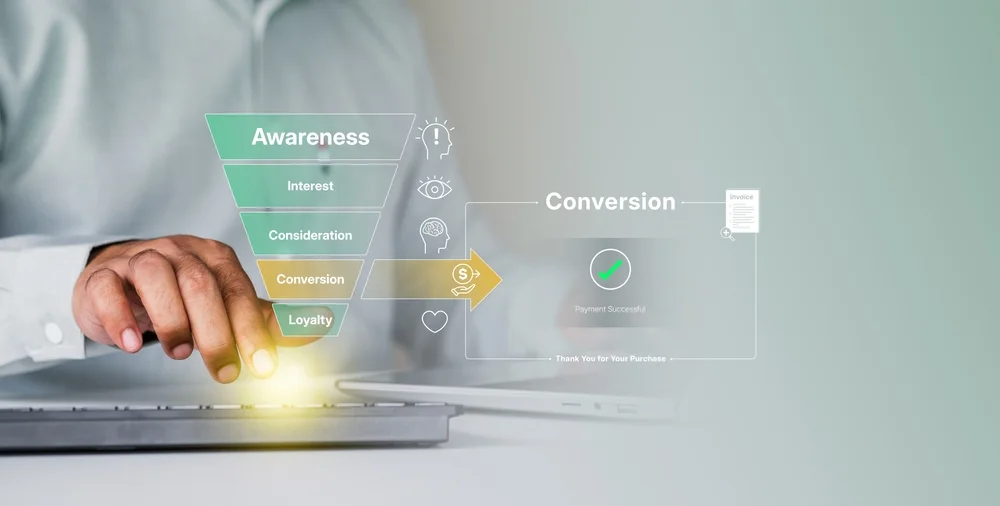
A B2B digital marketing funnel helps organize your activities around the stages of the buying journey.
It provides a framework for understanding what prospects need to know, which interactions may indicate interest, and when they’re ready for a conversation with sales.
A common model includes three stages: awareness, consideration, and decision.
| Funnel stage | What the prospect is thinking | Marketing opportunities |
| Awareness | “We have a problem. What are our options?” | Educational articles, SEO, industry content, introductory webinars |
| Consideration | “Which approach or provider makes sense for us?” | Comparison guides, case studies, email nurturing, targeted campaigns |
| Decision | “Can this company meet our requirements?” | Product demos, consultations, proposals, service-specific landing pages |
At the awareness stage, your audience may not know exactly what solution they need.
For example, a manufacturing company experiencing frequent equipment downtime might begin by researching possible causes, maintenance strategies, or ways to improve operational efficiency.
At this point, an aggressive sales message may be less useful than an article explaining common challenges and potential approaches.
Your goal is to help the prospect understand the problem and recognize possible solutions.
SEO, educational content, and relevant awareness campaigns can support this stage.
During consideration, the prospect has a clearer understanding of the problem and begins comparing approaches.
The manufacturing company might now be evaluating preventive maintenance providers, monitoring software, or equipment upgrades.
This is where detailed service information, case studies, comparisons, and practical resources become valuable.
Your content should help prospects understand how different solutions work, what implementation involves, and which factors they should consider.
Rather than simply saying your company is the best option, explain the capabilities and considerations that make your solution relevant.
At the decision stage, prospects are evaluating specific providers.
They may want to discuss pricing, timelines, technical requirements, service agreements, or expected outcomes.
Your website should make it easy to request a consultation, schedule a demonstration, or contact the appropriate team.
Clear service descriptions, relevant case studies, and straightforward contact processes can help reduce friction.
However, the B2B buying journey isn’t always linear.
A prospect might read a case study before exploring your educational content. Another might request a demonstration and then return to your website to compare features.
Different stakeholders within the same organization may also enter the process at different stages.
That’s why your funnel should guide your marketing strategy without assuming every customer follows the same sequence.
A useful approach is to map your content and campaigns to the questions prospects are likely to ask.
For example, if your business provides accounting software to Canadian companies, your content could address common financial reporting challenges during awareness, explain software features and integration requirements during consideration, and offer demonstrations or consultations during decision.
Each interaction should help prospects make progress toward understanding whether your solution meets their needs.
This is also where marketing and sales alignment becomes essential.
Your marketing team may define a qualified lead based on company size, industry, job role, and engagement with specific content.
Your sales team may evaluate additional factors, including budget, purchasing authority, implementation requirements, and project timelines.
If these teams don’t agree on what makes a lead valuable, marketing may generate contacts that sales considers irrelevant.
A well-designed funnel helps establish a shared understanding of the customer journey.
It also creates opportunities to identify where prospects lose interest, which content supports meaningful engagement, and where your conversion process needs improvement.
For companies investing in internet marketing in Canada, the objective should be to connect channels, content, and sales activities into a consistent experience.
After all, a successful B2B funnel isn’t just about moving people from one page to another.
It’s about helping the right businesses make informed decisions while creating opportunities for your sales team to build relationships with potential customers.
How to Generate Qualified B2B Leads
Getting someone to fill out a contact form is a good start. But what happens next?
If your sales team spends most of its time contacting people who aren’t interested, don’t have the budget, or aren’t a good fit for your services, generating more leads won’t necessarily solve the problem.
What you need is a strategy that attracts businesses with a genuine need for what you offer.
That’s where qualified B2B lead generation comes in.
A qualified lead is a prospect who meets certain criteria that make them a potential customer. These criteria may include industry, company size, location, business needs, purchasing authority, and readiness to buy.
For example, imagine your company provides enterprise cybersecurity solutions for organizations with more than 100 employees.
A student downloading your cybersecurity guide may find the content useful, but they probably aren’t a sales opportunity. An IT director at a growing company researching security providers could be a much stronger match.
Both interactions may appear as conversions in your analytics platform, but they don’t represent the same business value.
This is why your lead generation strategy should begin with a clear ideal customer profile (ICP).
Your ICP describes the types of organizations most likely to benefit from your products or services. It helps you determine which industries to target, what company characteristics matter, and which challenges your marketing should address.
Once you’ve defined your audience, you can create campaigns and conversion experiences that speak directly to their needs.
Create Landing Pages That Attract the Right Prospects
A generic landing page that lists every service your company offers may not provide enough information for someone researching a particular solution.
Instead, consider creating pages focused on specific services, industries, or use cases.
For example, a company offering logistics software might develop separate landing pages for warehouse management, inventory tracking, and supply chain visibility.
Each page can explain the relevant problem, describe the solution, and provide a clear next step.
The goal isn’t to create dozens of nearly identical pages. It’s to give potential customers information that matches their interests and helps them decide whether to contact you.
Your landing pages should also make the conversion process straightforward.
Long forms can discourage prospects from completing an inquiry, particularly when they’re still exploring their options.
At the same time, collecting too little information may make it difficult for your sales team to understand the request.
The right balance depends on the conversion.
A newsletter subscription might only require an email address, while a consultation request could reasonably ask for a company name, business email, and brief description of the project.
You can also use progressive profiling or follow-up conversations to gather additional information over time.
Make sure your forms clearly explain how submitted information will be used and follow applicable privacy requirements.
Use Lead Magnets and Content to Support Buying Decisions
Not every prospect is ready to request a proposal.
Some may be comparing approaches, researching implementation requirements, or preparing a business case for their organization.
Resources such as case studies, webinars, practical guides, and product demonstrations can support these needs.
For example, a business considering new HR software might appreciate a guide explaining how to evaluate different platforms before scheduling a demonstration.
However, you don’t need to place every resource behind a form.
Making educational content freely accessible can help potential customers evaluate your expertise without creating unnecessary barriers.
Reserve lead capture forms for situations where exchanging contact information provides clear value, such as requesting a consultation, registering for a relevant event, or accessing a specialized resource.
The objective is to offer something genuinely useful, not simply collect email addresses.
Understand the Difference Between MQLs and SQLs
Once someone submits an inquiry, your marketing strategy shouldn’t end.
A customer relationship management (CRM) system can help organize prospect information, track interactions, and support follow-up activities.
It can also help distinguish between different levels of lead qualification.
Two common terms are:
- Marketing Qualified Lead (MQL): A prospect who meets your marketing team’s criteria for potential sales relevance, based on fit, engagement, or other defined signals.
- Sales Qualified Lead (SQL): A prospect your sales team has evaluated and considers appropriate for direct sales engagement.
These definitions aren’t universal. Your organization should establish criteria that reflect its actual sales process.
For example, downloading a guide doesn’t automatically make someone an MQL, and requesting a demonstration doesn’t guarantee that they’re an SQL.
Qualification should consider both the prospect’s needs and whether your business can realistically serve them.
A strong lead generation strategy connects targeting, content, landing pages, CRM processes, and sales follow-up.
That coordination is what helps turn digital marketing activity into meaningful business opportunities.
How to Measure and Optimize Your B2B Marketing Performance
Let’s say your latest campaign generated 150 leads.
Is that a successful result?
It depends.
If most of those leads aren’t relevant to your business, the campaign may be generating activity without contributing much to your sales pipeline.
On the other hand, a campaign producing 25 highly qualified inquiries could be more valuable if those prospects are a strong match for your services.
This is why B2B marketing performance should be evaluated beyond traffic, clicks, and form submissions.
Those metrics still matter, but they don’t tell you everything about the quality of your opportunities.
B2B Marketing Metrics That Actually Matter
Consider the following measurements:
| Metric | What it measures | Why it matters |
| Conversion rate | Percentage of visitors who complete a defined action | Helps evaluate landing pages and campaign relevance |
| Cost per lead (CPL) | Marketing spend divided by leads generated | Shows the cost of acquiring inquiries |
| Cost per qualified lead | Marketing spend divided by qualified leads | Helps compare lead generation efficiency |
| MQL-to-SQL conversion rate | Percentage of MQLs accepted as SQLs | Indicates how well marketing qualification aligns with sales |
| Lead-to-customer conversion rate | Percentage of leads that become customers | Connects lead generation with actual outcomes |
| Customer acquisition cost (CAC) | Relevant acquisition costs divided by new customers | Helps assess acquisition efficiency |
| Marketing-sourced pipeline | Value of sales opportunities originating from marketing | Connects marketing activity with potential revenue |
The most useful metrics depend on your sales cycle and business model.
For example, a company selling high-value industrial equipment may generate relatively few leads each month. However, each qualified opportunity could represent a substantial potential contract.
A business offering a lower-cost subscription service may need a higher volume of conversions to reach its revenue objectives.
Neither approach is automatically better.
What matters is whether your marketing activities support your company’s financial and commercial goals.
You should also look at how performance changes throughout the funnel.
If your Google Ads campaigns generate relevant traffic but few inquiries, review your landing pages, messaging, and conversion process.
If you’re generating plenty of MQLs but very few become SQLs, the issue may involve targeting, qualification criteria, or a mismatch between marketing promises and sales requirements.
And if prospects reach the proposal stage but rarely become customers, the problem may extend beyond marketing into pricing, competitive positioning, or the sales process itself.
These patterns can help you decide where improvements are needed.
Understand Attribution Across the B2B Sales Funnel
B2B customers often interact with multiple channels before making a purchasing decision.
Someone might discover your company through an organic search, return through a LinkedIn campaign, read a case study, and eventually request a consultation after clicking a paid search advertisement.
If you only evaluate the final interaction, you may overlook earlier activities that contributed to the relationship.
Attribution models can help you analyze how different touchpoints contribute to conversions, but no single model captures every influence on a complex B2B purchase.
Use attribution data alongside CRM records, sales feedback, and other available information.
It’s also worth remembering that longer sales cycles can delay results.
A campaign launched this month may generate inquiries immediately, while the associated sales opportunities or revenue may not appear until later.
For companies investing in digital marketing services in Canada, setting realistic measurement periods is essential.
A successful strategy should help you understand both immediate campaign performance and longer-term contributions to your pipeline.
How a Digital Marketing Agency in Canada Can Support Your B2B Growth

Managing B2B marketing involves more than launching advertisements or publishing articles.
You need to understand your audience, coordinate different channels, evaluate lead quality, and connect marketing performance with business outcomes.
That’s why some organizations choose to work with a digital marketing agency in Canada rather than managing every activity internally.
The right agency can help identify opportunities, develop a coordinated strategy, and provide specialized support across different areas of digital marketing.
However, choosing an agency shouldn’t come down to the number of services listed on its website.
A provider offering SEO, PPC, social media, and content marketing isn’t necessarily the best fit for your business.
What matters is whether the team understands your objectives and can explain how its recommendations support them.
For example, if your main challenge is generating qualified leads for a specialized B2B service, an agency should be able to discuss audience targeting, commercial search intent, landing page optimization, and lead quality measurement.
If you’re struggling to convert existing traffic, the conversation may focus more on website usability, conversion tracking, and the customer journey.
An experienced digital agency in Canada should also recognize that B2B marketing performance can’t always be evaluated using the same benchmarks as consumer campaigns.
Longer sales cycles, smaller target audiences, and complex purchasing decisions require different expectations.
When comparing providers, consider whether they can demonstrate a clear approach to:
- Understanding your industry, audience, and business goals.
- Coordinating SEO, paid advertising, content, and conversion optimization.
- Measuring qualified leads and relevant pipeline outcomes.
- Communicating results and recommending improvements.
- Working with your internal marketing and sales teams.
You should also ask how the agency approaches reporting.
Will you receive only traffic and advertising metrics, or will the team help connect those numbers with lead quality and commercial objectives?
Clear reporting can make it easier to understand where your budget is going and which activities deserve further investment.
For businesses researching an internet marketing company in Canada or an online marketing agency in Canada, geographic knowledge can also be useful.
Canadian markets may involve different regional audiences, language requirements, industry regulations, and competitive conditions.
A strategy targeting businesses in Toronto may require different messaging or geographic considerations than one focused on Quebec or multiple provinces.
However, local market knowledge should complement strategic and technical capabilities, not replace them.
Ultimately, the right agency should help your business make informed decisions rather than simply recommend more campaigns.
Turn Your B2B Marketing Into Business Opportunities With MRKT360

Your B2B marketing strategy shouldn’t stop at generating website traffic or collecting contact information.
It should help your business reach relevant audiences, build credibility, and create opportunities that support your sales goals.
That requires connecting your marketing channels with the way your customers research, evaluate, and purchase solutions.
At MRKT360, we help businesses develop digital marketing strategies that bring together SEO, paid advertising, content marketing, and website optimization.
Whether you’re looking to attract more qualified prospects, improve your conversion process, or strengthen your online presence, our team can help you identify opportunities across your digital marketing activities.
As a digital marketing agency in Canada, we understand the importance of aligning your online marketing efforts with your business objectives.
From improving organic visibility to developing targeted advertising campaigns, the goal is to help you reach the right audience and make better use of your marketing investment.
If you’re exploring digital marketing services in Canada, the first step is understanding where your current strategy is performing well and where potential customers may be dropping out of the buying journey.
Ready to turn more of your marketing efforts into qualified business opportunities? Contact MRKT360 to discuss a B2B digital marketing strategy built around your goals.
About MRKT360
MRKT360 is a results-driven digital marketing and solutions agency offering end-to-end services in performance marketing, AI strategy, SEO, GEO, paid media, and IT optimization..
With clients around the world, MRKT360 specializes in future-proofing brands through innovative solutions that align marketing and infrastructure.
FAQs About B2B Digital Marketing
What is the difference between B2B and B2C digital marketing?
B2B digital marketing targets businesses and the professionals involved in purchasing decisions, while B2C marketing focuses on individual consumers.
B2B strategies typically involve longer sales cycles, multiple decision-makers, and a greater emphasis on demonstrating business value. Content such as case studies, industry guides, and product demonstrations can help prospects evaluate potential solutions before contacting a sales team.
Which digital marketing channel is best for B2B lead generation?
There’s no single channel that works best for every B2B company.
Google Ads can help capture prospects actively searching for solutions, while SEO and content marketing support organic discovery and research. LinkedIn can help businesses reach specific professional audiences, and email marketing can nurture relationships over time.
The right combination depends on your target audience, sales cycle, budget, and lead generation goals.
How much should a B2B company spend on digital marketing?
Your B2B digital marketing budget should reflect your revenue goals, customer acquisition costs, competitive landscape, and available resources.
Rather than relying on a fixed percentage, consider how much you can reasonably invest to acquire a qualified customer and which channels support your sales objectives.
A digital marketing agency in Canada can help you evaluate potential investments and develop a budget based on your business needs.
How long does B2B digital marketing take to generate results?
Results depend on the channels you use, your industry, and the length of your sales cycle.
Paid advertising can begin generating traffic and inquiries relatively quickly, while SEO and content marketing generally require more time to build organic visibility.
However, generating leads isn’t the same as closing sales. For B2B companies with longer purchasing cycles, measuring qualified opportunities and revenue may require several months or more.
Is SEO or PPC better for B2B companies?
Both can support B2B lead generation, but they serve different purposes.
SEO helps your business build organic visibility for relevant searches over time, while PPC allows you to reach targeted audiences through paid campaigns.
Combining both approaches can help you capture existing demand while developing a stronger long-term search presence. The best allocation depends on your goals, competition, and available budget.
What makes a B2B lead qualified?
A qualified B2B lead is a prospect who meets criteria indicating that your business could be a suitable solution for their needs.
These criteria may include industry, company size, location, purchasing authority, business requirements, and readiness to buy.
Marketing and sales teams should agree on qualification standards so they can distinguish between general inquiries, marketing qualified leads (MQLs), and sales qualified leads (SQLs).
How can B2B companies improve their lead conversion rates?
Start by reviewing whether your campaigns attract the right audience and whether your landing pages address their needs.
Clear messaging, relevant offers, straightforward forms, and effective follow-up processes can help reduce friction.
You should also analyze lead quality, identify where prospects drop out of the funnel, and use CRM data to understand which marketing activities contribute to qualified opportunities.
Why work with a digital marketing agency in Canada?
Working with a digital marketing agency in Canada can give your business access to specialized expertise in SEO, paid advertising, content marketing, and conversion optimization.
An agency familiar with Canadian markets can also help account for regional competition, audience preferences, and relevant language or regulatory considerations.
The right partner should focus on connecting your marketing activities with qualified leads, sales opportunities, and measurable business objectives rather than simply increasing traffic.