
E-commerce has moved far beyond being an alternative to physical retail. Online shopping is now a fundamental part of how consumers discover products, compare prices, evaluate brands, and complete purchases.
The opportunity is enormous, but so is the competition. Customers can move between search engines, marketplaces, social platforms, mobile apps, and brand websites within minutes. At the same time, artificial intelligence is beginning to influence how products are discovered and recommended.
For e-commerce businesses, success increasingly depends on creating a fast, trustworthy, convenient, and connected shopping experience across every stage of the customer journey.
The Marketplace Has Become a Connected Ecosystem
The modern digital marketplace is no longer dominated by a handful of traditional online retailers.
Large marketplaces remain important, but merchants can also build their own stores, sell through social platforms, work with creators, use commerce-focused advertising, and reach customers through increasingly sophisticated digital channels.
The important distinction is that businesses no longer have to choose between their own e-commerce website and third-party marketplaces. A strong strategy can use both.
Marketplaces can provide:
- Access to large established audiences
- Additional product discovery opportunities
- Built-in payment infrastructure
- Customer reviews and social proof
- Fulfillment and logistics services
- International reach
At the same time, an independently operated e-commerce website gives a business considerably more control over its brand experience, customer relationships, product presentation, data, and long-term loyalty strategy.
The strongest merchants therefore treat marketplaces as an additional distribution channel rather than allowing them to become the entire business.
AI Is Changing How Customers Find Products
One of the most significant developments in e-commerce is the emergence of AI-assisted shopping.
Consumers are increasingly using conversational tools to research products, compare alternatives, ask questions, and obtain recommendations. This means that product discovery is beginning to move beyond traditional search results and marketplace listings.
Recent industry research shows just how quickly this behaviour is developing. DHL reports that 38% of global shoppers have already used AI-powered chat tools or virtual assistants to browse or buy online.
For merchants, this creates a new optimization challenge.
Product information needs to be:
- Accurate
- Detailed
- Consistent
- Easy for machines to interpret
- Structured clearly
- Supported by trustworthy information
- Aligned with the questions customers actually ask
Product descriptions written solely to fill a page are no longer enough. Businesses need comprehensive information that helps both customers and AI-driven discovery systems understand what a product is, who it is for, how it differs from alternatives, and why it is worth buying.
Give Customers More Ways to Pay
Payment flexibility has become an important part of the online shopping experience.
Customers increasingly expect to choose from familiar cards, digital wallets, bank-based payment options, and flexible financing solutions. The most appropriate mix varies considerably by market, product category, and customer demographic.
Digital wallets have become particularly important. Global Payments reports that digital wallets accounted for 56% of global e-commerce transaction value in its latest analysis, making them the leading consumer payment method for online purchases.
The lesson for merchants is straightforward: checkout should remove friction, not create it.
A customer who has already decided to buy should not abandon the purchase because their preferred payment method is unavailable.
Businesses should therefore evaluate:
- Which payment methods customers actually use
- Whether checkout works smoothly on mobile devices
- Whether payment options are clearly presented
- Whether financing options make sense for the product
- Whether customers can complete purchases quickly
- Whether international shoppers can use familiar local payment methods
More choice is valuable, but the experience must remain simple.
Mobile Commerce Is No Longer Optional
A significant share of e-commerce activity now takes place on smartphones.
The mobile experience therefore needs to be treated as a primary shopping environment, not as a smaller version of the desktop website.
Customers expect product pages to load quickly, images to display properly, navigation to be intuitive, and checkout to require as little effort as possible.
A mobile e-commerce experience should make it easy to:
Discover → Compare → Select → Pay → Track
Every unnecessary step creates another opportunity for abandonment.
This is particularly important because mobile shoppers are often operating in environments where attention is limited. They may be comparing products while commuting, standing in a store, watching television, or moving between apps.
The website must therefore communicate essential information quickly without overwhelming the customer.
Speed Can Make or Break a Sale
Performance remains one of the most controllable elements of an e-commerce website.
Large product images, unnecessary scripts, excessive tracking technologies, poorly optimized applications, and inefficient hosting can all slow down a store.
The original Google Analytics Site Speed resource referenced in the earlier version of this article is now a legacy Universal Analytics resource, so it is no longer appropriate to present it as a current e-commerce measurement solution.
Today, merchants should evaluate website performance using modern performance and user-experience measurements, including Core Web Vitals, browser performance tools, and current analytics platforms.
Pay particular attention to:
- Page loading performance
- Mobile responsiveness
- Interaction speed
- Layout stability
- Image optimization
- JavaScript execution
- Server response times
- Checkout performance
A beautiful online store that takes too long to become usable is still a poor shopping experience.
Make Advertising More Visual and More Relevant
E-commerce advertising has become increasingly visual.
Product demonstrations, short-form video, creator content, user-generated content, interactive formats, and highly tailored creative can all help consumers understand products before they purchase them.
This is especially valuable for products whose benefits are difficult to communicate through text alone.
A beauty product can be demonstrated. A piece of clothing can be shown in use. A household product can solve a problem on camera. A technical product can be compared with alternatives.
The objective is not simply to make advertisements more attractive. It is to reduce uncertainty before purchase.
Social commerce is reinforcing this shift. DHL’s latest research shows that 63% of businesses sell through social platforms, while 45% of shoppers buy through them, illustrating both the opportunity and the gap between merchant activity and consumer behaviour.
That gap matters.
Being present on a social platform does not automatically mean customers will purchase there. Merchants still need compelling creative, credible reviews, competitive offers, clear product information, and a frictionless path to checkout.
Trust Is a Competitive Advantage
Online shoppers cannot physically inspect a product before purchasing it. They therefore depend heavily on information and signals that reduce uncertainty.
Reviews, ratings, customer photographs, demonstrations, return policies, delivery information, guarantees, and transparent pricing can all influence the decision.
User-generated content is particularly valuable because it shows products in real-world situations rather than exclusively through professionally produced brand imagery.
This is one reason why e-commerce businesses should actively encourage customers to share their experiences.
Trust can also be strengthened by:
- Clearly displaying delivery times
- Explaining return conditions
- Showing the full price before checkout
- Providing accurate product specifications
- Answering common customer questions
- Using high-quality product photography
- Displaying authentic reviews
- Maintaining consistent brand information
The objective is to eliminate as many unanswered questions as possible before the customer reaches the payment screen.
Delivery and Returns Are Part of the Product
The transaction does not end when someone clicks Buy.
Delivery and returns have become fundamental parts of the overall customer experience. A customer may love the product but still abandon the purchase if delivery options are inconvenient, expensive, or unclear.
DHL’s e-commerce research found that 81% of shoppers abandon carts when their preferred delivery options are unavailable.
That makes logistics a marketing issue as well as an operational one.
Businesses should clearly communicate:
- Delivery costs
- Estimated delivery times
- Available shipping methods
- Tracking information
- International shipping conditions
- Return procedures
- Refund timelines
Convenience after the sale can directly influence whether a customer buys again.
Build an Experience Customers Want to Return To
Acquiring a customer is only one part of e-commerce growth.
A successful store should also give customers reasons to return.
Personalized recommendations, loyalty programs, relevant email communication, subscriptions, replenishment services, useful content, exclusive offers, and excellent customer service can all contribute to repeat purchases.
But personalization should serve a purpose. Showing a genuinely relevant customer products is useful. Bombarding them with irrelevant promotions is not.
The objective should be to create an experience that becomes more useful with every interaction.
E-commerce Is Moving Beyond the Traditional Website
The most important change is perhaps the disappearance of clear boundaries between different commerce channels.
A customer may discover a product through a social video, investigate it through an AI assistant, compare prices on a marketplace, read reviews on a brand website, and complete the purchase on a smartphone.
The customer does not care which marketing channel is responsible for each step.
The business needs to make the entire journey work.
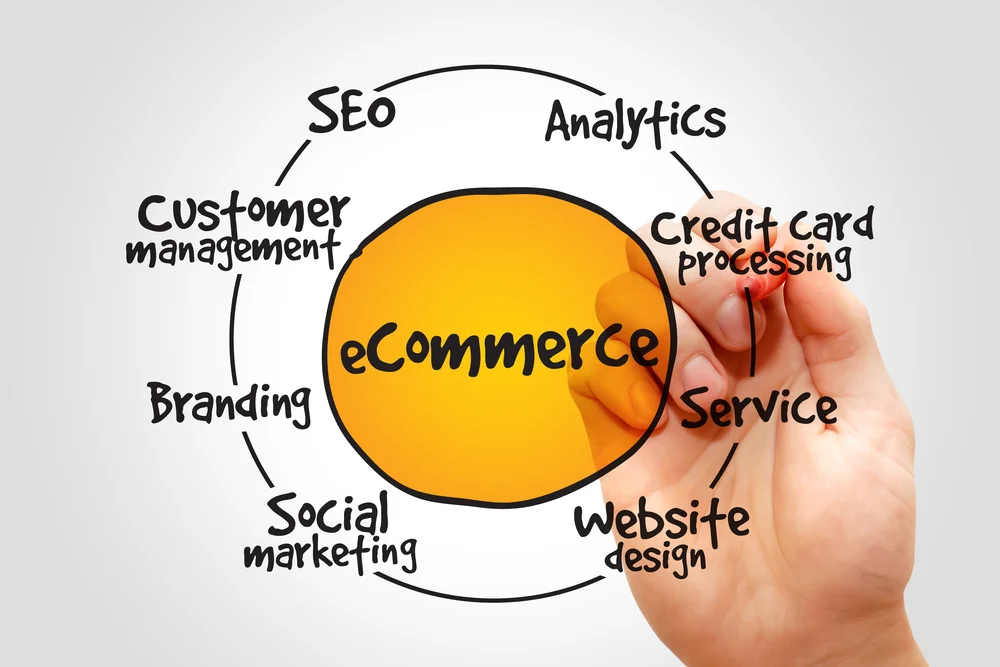
That means connecting SEO, paid advertising, social media, content, product data, analytics, website experience, payments, fulfillment, and customer retention rather than managing each component in isolation.
E-commerce businesses that build this connected experience can compete on much more than price.
Stay Ready for the Next Shift
The digital marketplace will continue to evolve. AI-assisted shopping, social commerce, mobile purchasing, digital wallets, creator-driven discovery, personalization, and increasingly sophisticated automation are changing how consumers find and buy products.
But technological innovation does not eliminate the fundamentals.
Customers still want good products, fair prices, trustworthy information, convenient payment options, fast delivery, simple returns, and an experience that respects their time.
The merchants most likely to succeed are those that combine these fundamentals with the technology necessary to make the entire shopping journey faster, easier, more relevant, and more trustworthy.
For businesses looking to increase e-commerce traffic, improve their online presence, optimize their website, and generate more conversions, MRKT360 can help develop and manage digital marketing strategies built around measurable business results. Contact us today.
Get a free PDF about Ecommerce: How to succeed in the digital marketplace