If you’ve spent years investing in SEO, hearing terms like Generative Engine Optimization (GEO) can feel a little daunting, to say the least.
It sounds like another acronym. Another trend. And perhaps another reason to rethink the digital strategy you’ve built for the past decade.
Fortunately, that isn’t really what is happening.
The rise of AI-powered search has undoubtedly changed how people discover information online. Users are increasingly turning to Google AI Overviews, ChatGPT, Gemini, and Perplexity to answer questions that they would have typed into a traditional search engine just a few years ago. As a result, many businesses are asking themselves whether the rules of visibility have fundamentally changed.
That is a fair question.
But the answer is much more reassuring than many headlines would have you believe.
Search engine optimization is not disappearing. It is evolving alongside the way people search, and businesses that understand that shift will be much better prepared for what comes next. In fact, many of the same principles that have supported successful SEO strategies for years continue to play an important role in AI-powered search experiences.
Think about it this way.
Ten years ago, most businesses focused almost exclusively on Google. Today, customers can discover brands through search engines, AI assistants, YouTube, social media, and generative search experiences—all within the same buying journey. Search did not get replaced.
It simply got bigger.
And that is exactly why understanding GEO vs traditional SEO has become increasingly important for businesses preparing for the future of digital visibility.
SEO Didn’t Go Anywhere—Search Simply Got Bigger

If your business has spent years investing in SEO, here’s some good news: you do not need to start over.
Traditional search engine optimization still provides the foundation that modern search experiences depend on. Search engines continue evaluating many of the same signals they always have, including website performance, content quality, backlinks, user experience, authority, and technical health. Those factors remain incredibly valuable because they help determine whether a website deserves visibility in the first place.
And honestly, that should not come as a surprise.
AI systems still need trustworthy information to generate answers. If a website loads slowly, lacks credibility, or provides incomplete information, artificial intelligence cannot magically transform it into an authoritative source. In many ways, AI is reinforcing the importance of good SEO rather than diminishing it.
That is why experienced SEO services continue investing in technical excellence, helpful content, and long-term authority building.
The difference today is that businesses now have more places where visibility can happen. Traditional search remains important, but it is no longer the only destination where customers discover brands, compare solutions, and make decisions.
In other words, SEO did not become less important.
Its ecosystem simply expanded.
What Is Generative Engine Optimization?

So, if SEO is still here, what exactly is GEO?
Generative Engine Optimization (GEO) refers to the process of improving a brand’s visibility within AI-generated search experiences. Instead of focusing exclusively on rankings, GEO focuses on helping businesses become part of the answers generated by platforms like ChatGPT, Gemini, Perplexity, and Google AI Overviews.
That distinction matters.
Traditional SEO asks:
“How do I rank for this keyword?”
GEO asks:
“How do I become a trusted source that AI chooses to reference?”
You have probably experienced this shift yourself without even realizing it. Perhaps you asked ChatGPT to recommend project management software or used Google AI Overviews to compare different services before visiting a company’s website. Those interactions are becoming increasingly common, and they represent an important change in how people gather information online.
That is one reason why interest in GEO marketing and LLM optimization continues growing.
The good news is that businesses do not need to learn an entirely new playbook. Many of the qualities that support GEO—authority, trust, helpful content, semantic relevance, and topical depth—are already familiar to organizations that have invested in SEO over the years.
The challenge is not abandoning what works.
It is learning how to apply those principles across a much broader search landscape.
GEO vs Traditional SEO: What Is Actually Different?
Much like the conversation surrounding AI itself, discussions about GEO sometimes create the impression that businesses need to choose one strategy over another.
That is not really what is happening.
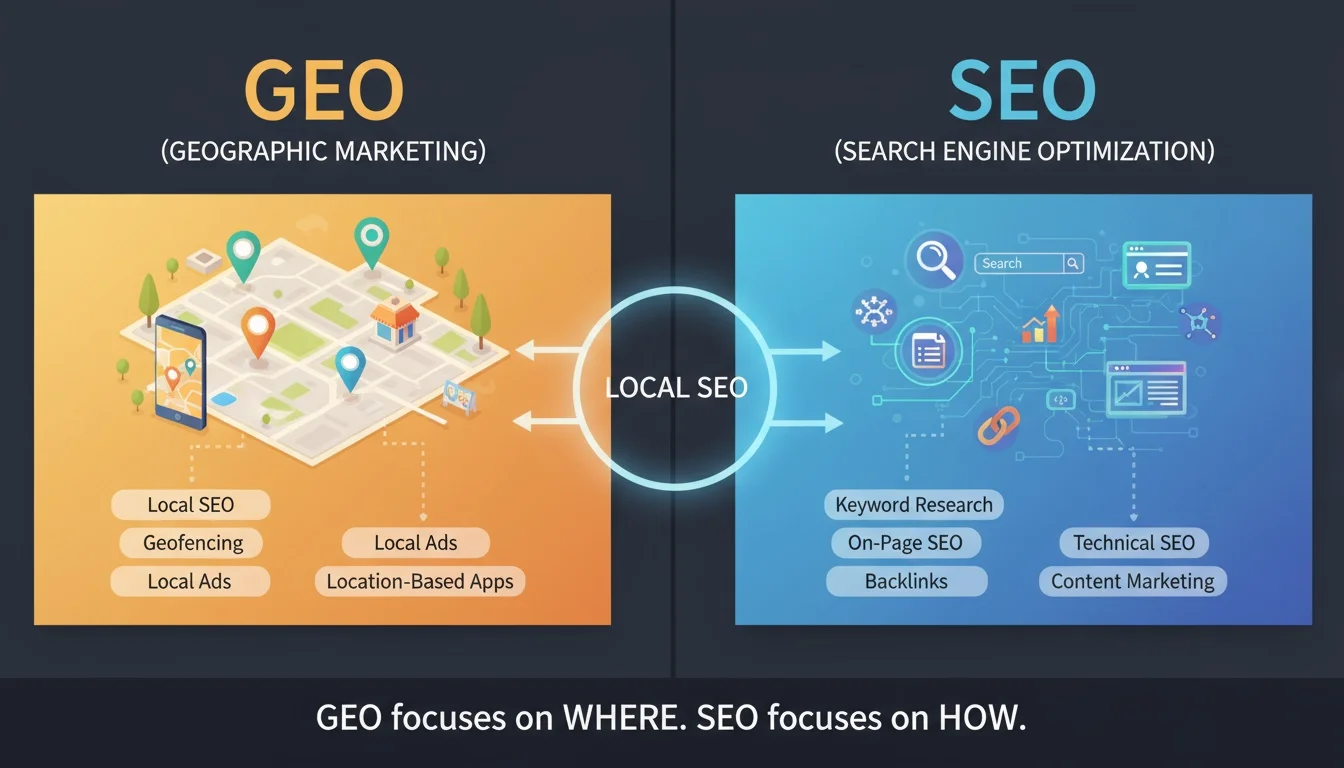
Traditional SEO and GEO have more in common than many people realize. Both exist to improve visibility, connect users with valuable information, and help businesses build authority over time. The biggest difference is not the objective—it is where that visibility happens.
A simple way to think about it looks like this:
| Traditional SEO | GEO |
| Focuses on rankings | Focuses on AI visibility |
| Prioritizes search engines | Prioritizes generative platforms |
| Optimizes pages | Optimizes answers and context |
| Measures SERP performance | Measures AI mentions and citations |
| Targets Google and Bing | Targets ChatGPT, Gemini, Perplexity, and AI Overviews |
Looking at the table, it is easy to assume that GEO and SEO are fundamentally different disciplines.
In reality, they are much closer than they appear.
Think about the journey a customer might take today. They could ask ChatGPT for recommendations during their morning commute, validate those recommendations through Google later that day, read a few reviews, and finally visit your website before making a decision. Throughout that process, both GEO and SEO are influencing visibility at different moments of the customer journey.
Traditional SEO helps businesses earn rankings.
GEO helps businesses earn mentions.
And increasingly, both matter.
There is also an important difference in how success is measured. Traditional SEO teams have spent years focusing on rankings, impressions, clicks, and organic traffic. GEO introduces an entirely new set of questions that businesses are only beginning to explore.
Questions like:
- Is our brand appearing in AI-generated responses?
- Are AI systems citing our content?
- Which topics are we becoming associated with?
- Are we increasing visibility across LLM platforms?
- Are customers discovering us before they ever reach Google?
Those metrics are still evolving, but they are becoming increasingly important as AI-powered search continues growing.
Content strategies are changing as well.
Traditional SEO often focuses on optimizing individual pages around target keywords. GEO encourages businesses to think more broadly by building interconnected content ecosystems that demonstrate expertise across an entire subject area. That shift encourages businesses to think beyond individual pages and focus on becoming trusted sources of information across an entire topic.
And honestly, this is where things become particularly interesting.
Imagine two companies offering the same software.
Company A ranks first for several high-volume keywords but rarely appears in AI-generated answers. Company B ranks slightly lower in traditional search results but is consistently referenced by ChatGPT, Gemini, and Google AI Overviews.
Which company is more visible?
Increasingly, the answer may be both.
That is why businesses should stop thinking about GEO and SEO as competing priorities. One helps customers discover your website through traditional search engines. The other helps customers discover your expertise before they even begin searching.
Ultimately, GEO and SEO are solving the same problem:
Helping people find trustworthy information.
The difference is that one optimizes for where search has been, while the other helps businesses prepare for where search is going.
AI Search Is Creating New Places to Be Found

For many years, visibility followed a fairly predictable pattern.
Someone searched Google. They clicked a result. They visited a website.
Today, the customer journey looks much less linear.
A potential customer might begin by asking ChatGPT a question during breakfast, continue their research using Google AI Overviews during lunch, watch product comparisons on YouTube later that afternoon, and finally visit your website before making a decision. All of those interactions can happen within a single day.
Search has become significantly more fragmented.
And with that fragmentation comes opportunity.
Businesses no longer need to think exclusively about rankings. Appearing consistently across multiple touchpoints—including AI-generated answers—can be just as valuable as ranking in a traditional search result. In some cases, it may even be more valuable because it introduces brands earlier in the decision-making process.
That is one of the biggest shifts businesses need to understand as they begin learning how to optimize for AI search.
Visibility is no longer tied to one platform.
It is becoming an ecosystem that spans search engines, AI assistants, and every digital experience in between.
Why Businesses Need Both GEO and SEO

By now, you may be asking yourself a fairly simple question:
Do businesses really need both GEO and SEO?
The short answer is yes. But perhaps a better answer is that businesses need a visibility strategy that reflects how people actually search today.
Customers do not think in terms of channels.
They are not asking themselves whether they should use Google, ChatGPT, or Gemini. They simply want the fastest, most trustworthy answer available. That means businesses need to stop thinking about visibility as a single destination and start thinking about it as a connected experience that spans multiple platforms.
Think about your own behavior for a moment.
You might ask ChatGPT a question, validate the answer through Google, read a few reviews, visit a company’s website, and then make a decision—all within the span of twenty minutes. Most buying journeys no longer follow a straight line, and search strategies should not either.
That is why businesses should avoid viewing GEO and SEO as competing priorities. Traditional SEO continues helping websites rank and attract traffic, while Generative Engine Optimization helps brands remain visible across AI-powered experiences.
Together, they create something much more valuable:
Consistent visibility wherever customers are looking.
What Content Performs Best for GEO?

One of the biggest misconceptions surrounding GEO is that it requires an entirely new type of content.
Fortunately, that is not the case.
In fact, businesses that have spent years investing in high-quality content are often much closer to GEO readiness than they realize. Many of the same characteristics that support traditional search engine optimization are also some of the strongest signals for AI-generated search experiences.
AI platforms tend to favor content that is trustworthy, comprehensive, well-structured, and clearly demonstrates expertise. They are looking for sources that answer questions thoroughly rather than simply mentioning the right keywords.
That is why concepts like E-E-A-T, semantic SEO, and topical authority have become increasingly important over the past few years.
AI models do not think the same way search engines did a decade ago. They analyze relationships between topics, look for patterns across multiple sources, and attempt to determine whether a business appears credible enough to reference. The stronger your authority within a particular subject area, the easier it becomes for AI systems to understand where your expertise lies.
In many ways, GEO rewards businesses for doing what they should have been doing all along:
Creating genuinely helpful content.
And honestly, that is a trend most marketers should be happy to see.
How to Optimize for Both Search Engines and AI Platforms

At this point, one thing should be becoming increasingly clear:
You do not need two completely separate strategies.
Instead, businesses should focus on building a stronger digital foundation that supports visibility across both traditional search engines and AI-powered experiences. The organizations performing best today are usually the ones investing in practices that benefit both ecosystems simultaneously.
That often includes:
- strengthening technical SEO,
- creating semantically related content,
- building topical authority,
- implementing structured data,
- improving internal linking,
- publishing comprehensive FAQs,
- and formatting content in ways that are easy for both users and AI systems to understand.
Notice that none of those recommendations are particularly revolutionary.
Many have been part of successful search engine optimization strategies for years. The difference is that they now support a much broader ecosystem that includes search engines, AI assistants, generative search experiences, and whatever comes next.
That is why businesses investing in AI-first SEO often discover something surprising.
The best way to prepare for the future of search is not abandoning SEO.
It is becoming exceptionally good at it.
GEO Is Not the Future of SEO—It Is Part of It
By now, one thing should be clear:
GEO is not replacing SEO.
Traditional search is still responsible for billions of searches every day, and businesses will continue relying on search engine optimization to improve rankings, drive traffic, and build authority for years to come.
At the same time, AI-powered search is creating entirely new opportunities for visibility.
That means businesses no longer need to think in terms of “SEO or GEO.”
They need to think in terms of “SEO and GEO.”
Traditional SEO helps people find your website through search engines. GEO helps people discover your expertise through AI-generated answers. Together, they create a much more complete visibility strategy that reflects how people actually search today.
A modern digital strategy might look something like this:
- SEO drives organic traffic from Google and Bing.
- GEO increases visibility in ChatGPT, Gemini, and AI Overviews.
- Semantic SEO strengthens topical authority.
- Structured data helps search engines and AI systems understand your content.
- Helpful, trustworthy content supports every channel simultaneously.
Notice something interesting.
None of these strategies work against each other.
They all reinforce one another.
That is why businesses preparing for the future should not ask whether GEO will replace SEO. A better question is:
“How can we ensure our brand remains visible wherever our customers are searching?”
Because ultimately, that is what modern search looks like.
Not one platform. An entire ecosystem.
Ready to Build a Strategy for Search and AI?

Search is no longer confined to a single results page.
Today’s customers move between search engines, AI assistants, social platforms, and websites throughout the same journey. That means businesses need visibility strategies designed for a much larger ecosystem than they did even a few years ago.
At MRKT360, we help businesses combine proven SEO services, modern Generative Engine Optimization strategies, and AI-ready content frameworks designed to support long-term growth across both traditional and emerging search experiences.
Whether you’re looking to improve rankings, optimize for AI search, strengthen topical authority, or prepare your business for the future of digital discovery, our team can help.
Contact MRKT360 today to build a strategy designed for where search is headed next.
About MRKT360
MRKT360 is a results-driven digital marketing and solutions agency offering end-to-end services in performance marketing, AI strategy, SEO, GEO, paid media, and IT optimization.
With clients around the world, MRKT360 specializes in future-proofing brands through innovative solutions that align marketing and infrastructure.
FAQs
What is Generative Engine Optimization (GEO)?
Generative Engine Optimization (GEO) is the process of improving a brand’s visibility within AI-generated search experiences such as ChatGPT, Google AI Overviews, Gemini, and Perplexity.
How does GEO differ from traditional SEO?
Traditional SEO focuses on improving rankings in search engines, while GEO focuses on helping businesses become visible within AI-generated answers and conversational search experiences.
Is GEO replacing traditional SEO?
No. GEO is not replacing SEO. It is expanding where visibility happens and complementing traditional search engine optimization strategies.
Why should businesses invest in both GEO and SEO?
Businesses should invest in both because customers increasingly use a combination of search engines and AI platforms when researching products, services, and brands.
Do I need both GEO and SEO for my website?
Yes. SEO helps improve visibility in traditional search results, while GEO helps increase visibility within AI-powered experiences. Together, they create a more comprehensive digital strategy.
Why is GEO becoming important for digital marketing?
GEO is becoming more important because AI-powered search continues growing, and businesses need to ensure they remain visible wherever customers are looking for information.
Can GEO help improve visibility in Google AI Overviews?
Yes. While there are no guarantees, businesses that create authoritative, well-structured content are generally better positioned to appear in AI-generated experiences such as Google AI Overviews.
What types of content perform best for GEO?
Long-form guides, FAQs, educational resources, case studies, and content that comprehensively answers user questions tend to perform particularly well.
What role does structured data play in GEO and SEO?
Structured data helps search engines and AI systems better understand your content, improving the likelihood of being surfaced in both traditional and AI-powered search experiences.