


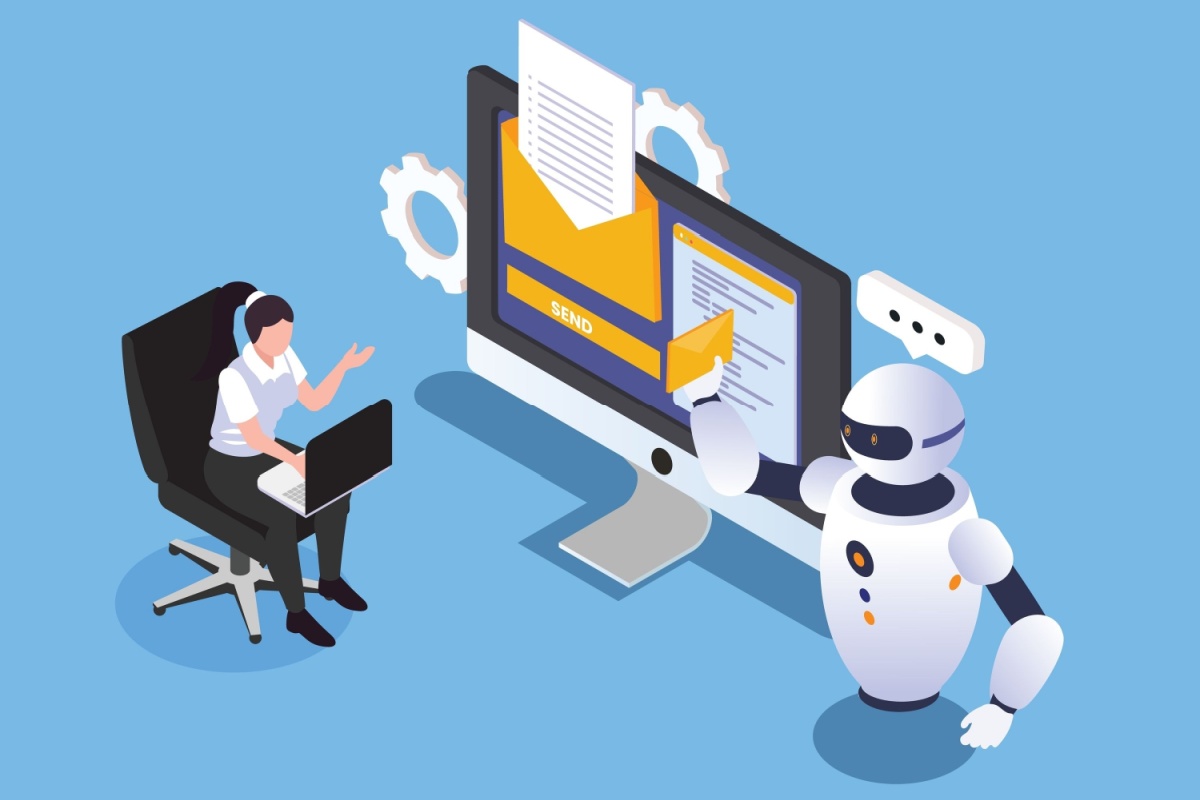
AI Agents Explained: What They Are & How They Work
A practical guide to AI agents, how autonomous systems use tools, memory, and guardrails to execute real workflows end to end for your business.
AI agents are quickly becoming the most practical way to turn AI from “something that answers questions” into “something that gets work done.” Instead of stopping at conversation, agents are designed to act: they can plan steps, use tools, remember context, and complete multi-step tasks with less human back-and-forth.
That shift matters because most real business work is not a single prompt. It’s a chain of decisions: gather inputs, check constraints, take action in the right system, confirm outcomes, and repeat. AI agents are built for that workflow. When implemented well, they reduce friction across teams, shrink cycle times, and create a new layer of operational leverage—not because they “think like humans,” but because they can execute like software with a clearer understanding of intent.
What are AI agents?
AI agents are AI systems designed to operate with a degree of autonomy to accomplish goals, not just respond to prompts. Instead of producing isolated answers, agents interpret objectives, plan actions, and carry them out—often across multiple steps, tools, and systems.
A practical way to understand an AI agent is as a goal-driven system that moves from understanding to execution. Where a traditional AI interface may return information, an agent can take action: search for data, retrieve records, update documents, trigger workflows, or complete tasks based on defined permissions.
What defines an AI agent is not a single model, but how multiple capabilities are coordinated to produce outcomes.
How Do AI Agents Work?
Most AI agents follow a loop that looks simple on paper but becomes powerful in real workflows: perception → reasoning → action → memory.
The agent starts with perception, meaning it receives input from a user or a system. This could be a request in natural language, a customer ticket, analytics signals, or structured data from an internal tool. Next comes reasoning, where a large language model (LLM) or a planning module interprets the goal, identifies constraints, and maps out steps. Then comes action, where the agent uses tools to execute those steps—anything from searching a knowledge base to updating a CRM record. Finally, memory captures what happened, so the agent can maintain continuity and improve future decisions.
This loop is the core difference between an agent and a single-response AI experience. Agents are built to continue until the task is completed or a human decision is required.
How AI agents work
In practice, AI agents operate through a structured loop that connects input, decision-making, and execution. Their effectiveness depends less on language fluency and more on how this loop is designed.
First, an AI agent receives input. This can be a user goal, a system trigger, or data from an external source. The input defines what the agent is trying to accomplish, not just what it should say.
Next, the agent interprets the goal and plans actions. Using a language model, it breaks the objective into steps and determines which actions are required to move forward. This planning phase depends heavily on constraints: what the agent is allowed to do, which tools it can access, and where human approval is required.
The agent then uses tools to take action. This may include querying databases, calling APIs, updating systems, sending messages, or executing predefined workflows. The quality of these actions depends on the reliability of the tools and data the agent can access.
Finally, the agent evaluates outcomes and retains context. Results are checked against the original goal, errors are logged, and relevant information is stored in memory to inform future actions. This feedback loop allows agents to improve consistency over time.
When AI agents fail, it is rarely because of language generation. Failures typically stem from poor system design: unclear permissions, missing validation steps, weak data sources, or lack of monitoring. In real deployments, an AI agent is only as effective as the workflow, safeguards, and governance surrounding it.
What Are the Components of an AI Agent?
An AI agent is a system, not a single feature. The most common components include:
- A reasoning engine (often an LLM): Interprets intent, generates plans, and decides next actions.
- A planning layer: Breaks goals into steps, manages dependencies, and decides what to do first.
- Tool connectors: Integrations that let the agent search, retrieve data, trigger workflows, or update platforms via APIs and internal systems.
- Memory: Stores relevant context such as prior interactions, preferences, task history, and sometimes learned heuristics.
- A control layer (guardrails): Defines permissions, validation steps, safety checks, and escalation rules for human review.
- Feedback mechanisms: Captures outcomes and user corrections so the agent improves reliability over time.
These components matter because they clarify what an agent can actually do. Many “agent” claims collapse under inspection because tool access and guardrails are missing.
What Are the Types of AI Agents?
There are multiple ways to categorize AI agents, but the most useful classification focuses on capability and autonomy.
Some agents are reactive, responding to inputs without long-term planning. Others are goal-driven, able to plan steps and manage multi-stage tasks. More advanced agents are multi-agent systems, where different specialized agents coordinate—one handles research, another handles execution, and another handles validation.
You’ll also see agents categorized by environment: customer-facing agents, internal ops agents, developer agents, analytics agents, and creative production agents. The label matters less than the architecture: what tools they can use, what decisions they can make, and how they handle uncertainty.
What Do AI Agents Do?
AI agents are best at work that is repetitive, multi-step, and context-heavy. They can:
They can interpret requests, gather information from multiple sources, generate outputs in the correct format, and take action inside business systems. In many teams, the first measurable impact shows up in “workflow compression”—fewer handoffs, fewer manual steps, and faster completion.
Agents also reduce the coordination overhead that slows modern teams down. Instead of a person jumping between five platforms, the agent becomes the layer that connects them, while humans focus on higher-value decisions.
How Do You Use AI Agents?
Using AI agents effectively starts with choosing the right scope. The best early use cases are narrow enough to control, but meaningful enough to deliver value quickly.
A practical approach is to define a single outcome, such as “triage inbound leads,” “prepare a weekly performance summary,” or “draft first-pass support replies using our knowledge base.” From there, you connect the agent to the required tools, define what “done” means, and add checkpoints where human review is required.
The strongest implementations treat agents like new hires: you give them a role, access, and rules. You don’t give them everything at once. Adoption improves when teams trust the agent’s boundaries as much as its outputs.
AI Agents vs. AI Chatbots
AI chatbots and AI agents are often confused, but they serve different roles within intelligent systems. AI chatbots are designed primarily for conversation. They respond to user prompts, generate text-based answers, and support tasks such as customer support, information retrieval, or content assistance within a conversational interface.
AI agents go beyond conversation. While they may include a conversational layer, their core capability is action. AI agents can plan multi-step tasks, make decisions, use external tools, and execute actions autonomously. Instead of waiting for each prompt, agents operate toward goals, adjusting their behavior based on context, memory, and outcomes.
The key distinction lies in autonomy and execution. AI chatbots assist users through dialogue, while AI agents act on behalf of users to complete tasks. In practice, chatbots answer questions; agents solve problems.
What is the difference between AI agents, AI assistants, and bots?
These terms are often used interchangeably, but there are real differences in capability and expectation.
Bots are typically rule-based or scripted systems designed for narrow tasks. They work well in structured environments but struggle with ambiguity. AI assistants are usually interactive helpers: they answer questions, draft content, and support decision-making, but they may not execute multi-step workflows without guidance. AI agents are designed to move beyond assistance into autonomy, using planning, tools, and memory to complete tasks end to end.
In practice, the difference shows up in ownership. Assistants support humans. Agents take ownership of tasks within defined boundaries. When businesses adopt agents, they’re not just improving “response quality”—they’re reshaping how work moves.
How Are Businesses Using AI Agents Today?
Businesses are deploying AI agents where speed, consistency, and cross-system coordination matter.
In customer service, agents can handle complex queries by pulling data from policy docs, order systems, and CRM history, then taking actions such as issuing refunds, scheduling appointments, or escalating cases with context. In IT and operations, agents can automate routine diagnostics, generate documentation, support testing workflows, or manage internal tickets. In marketing, agents help teams optimize campaigns, generate and test creative variations, monitor performance, and turn insights into actions faster.
In healthcare and regulated industries, agent adoption tends to be more cautious. The emphasis is on decision support, documentation assistance, and workflow coordination with strict human review. The pattern remains consistent: agents deliver value when they reduce friction without removing accountability.
At MRKT360, AI agents are approached as part of a broader marketing system rather than standalone experiments. Our work focuses on embedding agentic workflows into content, performance, analytics, and automation environments so AI can support real decisions, not just generate outputs.
This system-level approach allows AI agents to operate with clear objectives, governance, and measurable impact—aligning execution speed with long-term brand and growth goals.
Benefits of using AI agents
AI agents change how work is executed, coordinated, and evaluated inside organizations. Their value comes from reducing operational load and improving how decisions move from intent to action.
- Lower coordination overhead
AI agents manage multi-step tasks across tools and systems, reducing the need for manual handoffs, repeated context, or constant supervision. - More consistent execution across workflows
By applying the same logic and decision rules each time, agents reduce variability and help preserve institutional knowledge through memory and structured reasoning. - Shorter iteration cycles
AI agents can generate, test, and refine outputs continuously, allowing teams to move through experimentation and optimization faster than manual processes allow. - Faster movement from insight to action
Agents process inputs, evaluate options, and trigger next steps, reducing delays between analysis and execution. - Greater focus on high-value human work
When agents handle operational tasks, teams can concentrate on strategy, creative judgment, relationship management, and decisions that require context and accountability.
Are AI Agents the Future?
AI agents are not a trend in the “new feature” sense; they represent a shift in how software is built and used. As platforms evolve, we’re moving from interfaces that require constant human input to systems that can interpret goals and execute workflows.
That doesn’t mean agents replace teams. It means the baseline for productivity changes. Just as automation reshaped analytics and paid media, agentic systems will reshape how work is executed across marketing, operations, and support.
The organizations that benefit most will be those that treat agents as infrastructure: designed with governance, measurement, and clear boundaries, rather than adopted as experiments without ownership.
Key Takeaway
AI agents are autonomous, tool-enabled AI systems built to complete multi-step tasks—not just answer questions. They work through a loop of perception, reasoning, action, and memory, and they deliver value when connected to real tools with clear guardrails. For businesses, the shift to agents is less about adopting “more AI” and more about building workflows where AI can reliably execute, learn, and improve without sacrificing accountability.
Get Your Business AI-Ready with Mrkt360

Boost your marketing with AI. Get a FREE consultation today!
Ready to Improve your SEO?
Get a free SEO audit and digital marketing strategy session today!